Giant Tortoise Boom!

Mei
| 30-10-2026
 · Animal Team
An extraordinary wildlife survey has revealed that Seychelles is home to one of the world's most remarkable giant tortoise populations. On the remote Aldabra Atoll, researchers estimate that approximately 183,000 larger and near-mature tortoises inhabit the island's natural landscape.
The finding provides encouraging evidence of long-term conservation progress while giving scientists a more reliable way to monitor this unique population in the years ahead.
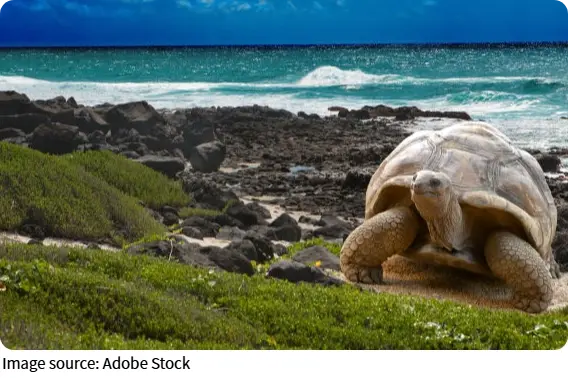
The research was conducted by the Seychelles Islands Foundation (SIF) and the University of Exeter. Beyond producing an impressive population estimate, the study highlights the importance of careful observation, improved scientific methods, and continued protection of fragile island ecosystems.
A Remarkable Population on Aldabra
Aldabra Atoll is part of the Seychelles, an island nation in the western Indian Ocean. It is internationally recognised for its distinctive natural environment and its population of Aldabra giant tortoises, scientifically known as Aldabrachelys gigantea.
The latest research places the population at approximately 180,000 individuals, with the most detailed estimate reaching almost 183,000. This makes Aldabra home to the largest known free-roaming giant tortoise population. Giant tortoises are naturally found in the wild in only two locations: Aldabra and the Galápagos Islands. The population on Aldabra is particularly significant because it demonstrates how sustained environmental protection and long-term scientific monitoring can support the recovery of a species.
How Researchers Estimated the Numbers
Counting thousands of large animals across a remote atoll is not as straightforward as it might seem. Vegetation can conceal tortoises from observers, while some areas are more difficult to survey than others. A simple count may therefore miss individuals that are present but not visible.
To address this challenge, researchers analysed five years of monitoring records collected between 2018 and 2022. Rather than relying exclusively on animals directly observed, they used statistical modelling to estimate how many might have remained unseen. This approach allowed the research team to account for differences in visibility across the landscape.
Why the New Figure Matters
A widely cited estimate from the late 1990s placed the Aldabra population at approximately 100,000 tortoises. The latest assessment is considerably higher, but researchers caution against interpreting the difference as proof that the population has nearly doubled. The methods used in earlier surveys were different and may not have accounted for every animal hidden by vegetation or shade.
The researchers found that the population was relatively stable during the monitoring period. This is an important result because it offers a clearer picture of the species' current status. The latest estimate also focuses mainly on larger tortoises. Very young individuals are harder to detect because they can remain concealed in dense vegetation.
A Long-Term Conservation Achievement
Aldabra's conservation story is closely connected to decades of environmental protection. The atoll became a strict nature reserve in 1981 and received UNESCO World Heritage status in 1982. These protections helped establish a framework for preserving its distinctive landscape and wildlife. The Seychelles Islands Foundation has continued monitoring the atoll, supporting scientific research and overseeing conservation activities.
Environmental Pressures Still Require Attention
Despite the encouraging findings, the tortoise population is not free from environmental risks. Researchers have highlighted concerns about changing climate conditions, particularly longer and more frequent periods of drought. Reduced rainfall can affect vegetation and limit the availability of food and natural shade. These conditions may become increasingly difficult for tortoises as temperatures and weather patterns shift.
Rising sea levels also present a concern because parts of Aldabra are low-lying. Changes to coastal environments could affect habitats and the long-term condition of the atoll. Invasive mammals are another concern. Feral cats and black rats can threaten tortoise eggs and hatchlings, making continued conservation work important for the population's future.
What the Research Means for Future Conservation
The study offers more than a headline-making number. Its improved approach to population estimation could help conservation specialists monitor other wildlife populations, particularly in locations where dense vegetation makes direct observation difficult. Researchers can use this information to identify areas that need closer attention and evaluate whether existing protection measures remain effective.

The estimate of nearly 183,000 Aldabra giant tortoises is an encouraging milestone for wildlife conservation in Seychelles. With reliable information and continued attention to environmental pressures, conservation teams can make better decisions for the future of Aldabra's remarkable wildlife.