Blue River Hunter
Finnegan Flynn
| 09-08-2026
 · Animal Team
Sometimes the smallest creatures can surprise us the most. Along a quiet riverbank, a tiny blue bird may sit calmly on a branch, watching the water without making a sound.
Then, in just a moment, it can dive straight into the water and return with its catch. This remarkable little hunter is the common kingfisher, a bird only about 16 to 17 centimeters long but packed with impressive skills.
Its bright blue feathers have earned it the charming nickname “flying sapphire.” When sunlight falls across its back, the bird can shine like a tiny jewel as it moves above the water.
A Beautiful Blue Coat
The common kingfisher has a bright blue back, a warm orange body, and a long pointed bill. Its colors make it easy to notice when it flies across a quiet stream. However, this beauty once created serious problems for these small birds. Their colorful feathers were used in traditional decorative crafts, and large numbers were needed for certain pieces.
Today, we can appreciate these birds in a better way. Watching a living kingfisher fly freely is much more meaningful than seeing its feathers used as decoration. When we protect rivers, wetlands, and healthy banks, we also give these colorful hunters a better place to live.
The Riverside Fisher
When we watch a kingfisher hunt, patience stands out first. The bird often chooses a branch, reed, or other perch near the water. It sits almost perfectly still while carefully watching the surface below.
Its head can move while the rest of its body remains quiet. This helps it observe different areas without wasting much energy. The bird waits until the timing feels right.
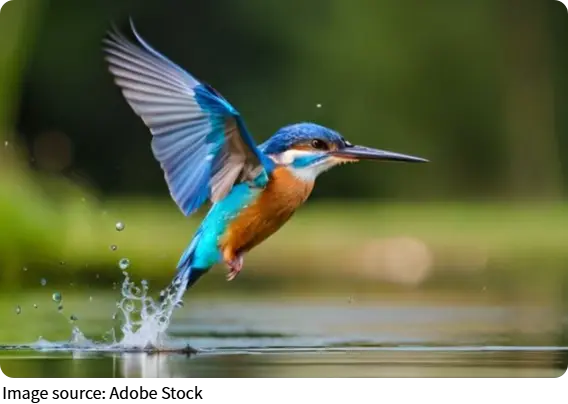
Then, in a sudden movement, it launches from the perch and dives toward the surface. Its streamlined body, strong bill, and excellent coordination help it enter the water quickly. From our viewpoint, the action can look like a small blue arrow dropping from the sky.
Eyes Built For Hunting
Finding prey under water presents a special challenge because light changes as it passes through the surface. The kingfisher has eye structures that help it adjust to this change quickly.
Once it enters the water, it can continue tracking its target with impressive accuracy. Its long and sturdy bill then helps it grasp the catch securely.
The whole process depends on timing. The bird needs to judge distance, movement, and position within a very short moment. This combination of vision and coordination makes the kingfisher a highly effective hunter despite its small size.
A Careful Way To Eat
Catching prey is only part of the story. After returning to a perch, the bird may repeatedly strike its catch against the branch before swallowing it. This behavior can make the meal easier to handle and may help reduce movement during feeding.
There is another interesting part of the process. Some hard material cannot be digested, so the bird gathers these remains into a compact pellet and later brings it back up. Researchers can examine such pellets to learn more about the bird’s diet.
A Hidden Riverside Home
Kingfishers have an unusual nesting habit. Rather than placing their home high in a tree, they often dig a tunnel into a suitable riverbank. The passage can lead to a protected chamber where the young are raised.
This arrangement puts the nest close to the bird’s main hunting area. A healthy riverbank therefore provides two important things at once: a safe place for raising young and easy access to food.
For us, this shows how closely wildlife depends on its surroundings. Even a quiet patch of soil beside a stream can have an important purpose.
One Fish Says Plenty
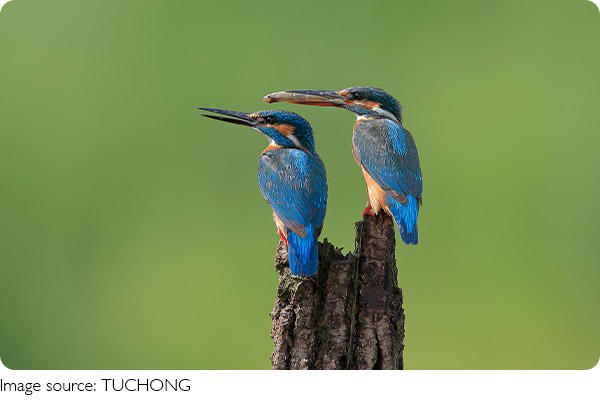
Kingfishers also have a simple and charming way of showing care within a pair. Food can become part of their interaction, with one bird sometimes bringing a fish to its partner.
From our perspective, the behavior feels almost like a small gift. There is no complicated performance involved. One useful catch can communicate attention in a very practical way.
It makes us smile when we imagine the situation: if one fish helps, perhaps another one can make the message even clearer.
Small Bird, Big Wonder
Lykkers, the common kingfisher reminds us that size tells us very little about ability. Inside this tiny body, we find sharp vision, fast movement, careful hunting, unusual feeding habits, and clever nesting behavior.
Next time we see a blue flash beside a stream, let’s pause for a moment instead of looking away. We may be watching one of nature’s most skilled little hunters at work.
Would you rather watch its sudden dive, its precise hunting technique, or the hidden tunnel where it raises its young? Tell us your choice, Lykkers, and let’s keep noticing the small wonders around us.
Common Kingfisher. Bird catching a fish. David Attenborough's opinion.
Video by Artur Homan